Trail Running vs. Hiking: Pace, Gear, and Terrain Compared
Stand at a popular trailhead on a Saturday morning and you will see both groups: the runners with their vests and soft flasks, bouncing on their toes while they adjust a lace, and the hikers with a proper pack, a map in hand, settling into a rhythm they can hold all day. From a distance the difference looks like nothing more than speed. Up close it is a different set of decisions entirely — how hard you are willing to work, what you wear on your feet, how much you carry, and what kind of ground the route actually offers. Neither choice is the more serious way to be outside. But they are different disciplines, and most of the discomfort people feel on the trail comes from borrowing the habits of one while doing the other.
Effort and Pace: Two Different Budgets
A hiker's pace is a conversation. You should be able to talk in full sentences for most of the day, with the climbs pushing you into short bursts of heavier breathing that ease once the ground flattens. That is the whole point: hiking spends effort slowly so the day can last six, eight, ten hours. Typical moving speeds on moderate ground sit somewhere around three to five kilometres an hour with a light pack, and vertical gain matters far more than distance. A flat fifteen kilometres is a pleasant afternoon; fifteen kilometres with 1,200 metres of climbing is a different animal.
Trail running borrows from a different account. The effort is higher, the duration shorter, and the terrain constantly interrupts whatever rhythm you were hoping for. Most trail runners spend a good share of a hilly route walking — often the steep climbs and the loosest descents — and that is not a failure of fitness. It is technique. On a mountainous route, running the flats and easy downhills while power-hiking the steep sections is usually faster and far less draining than forcing a jog up a 20 percent grade.
A useful way to compare the two: hiking is limited by how long your legs and feet tolerate being on the move, while trail running is limited by how well you manage intensity. Fuel and hydration follow the same logic. A hiker eats steadily and often; a runner has a smaller window and needs to drink before thirst arrives, especially on exposed ridgelines.
Footwear: Protection Versus Freedom
Shoes are where the two disciplines diverge most visibly, and where gear marketing does the most confusing.
Boots and mid-cut shoes
Stiff soles and higher uppers make sense when you are carrying weight, walking on sharp scree for hours, or moving through rough ground where a twisted ankle would be genuinely costly. Boots also keep feet cleaner in mud and cold. The trade is weight — every extra gram at the foot costs more than a gram in the pack — and less feel for the ground.
Trail runners
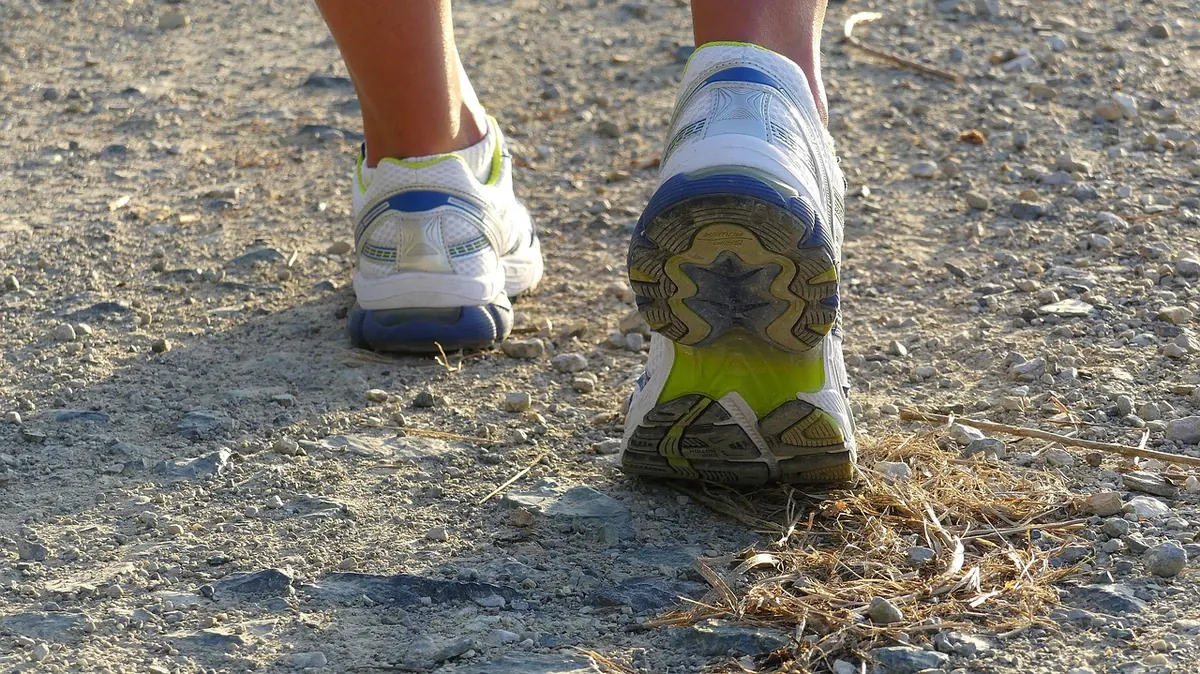
Low, light, and quick-drying, trail shoes suit anyone moving fast with a minimal load. A rock plate under the forefoot protects against sharp stones without turning the shoe into a plank. Lug depth is the detail worth checking: shallow, sticky rubber grips smooth rock and hardpack well, while deep, widely spaced lugs are built for mud and loose soil and feel vague on wet slabs.
Whichever you choose, the fit test is the same. Your toes should not touch the front when you walk downhill, and your heel should stay locked without cranking the laces. Thin wool or synthetic socks beat cotton every time. If you are running and expect grit, gaiters are cheap insurance against a day spent stopping to shake stones out.
Carrying Capacity: Vests Versus Packs
What you carry tends to follow how long you will be out and how fast you are moving. A trail running vest sits close to the body, carries two soft flasks at the chest so you can drink without stopping, and holds a shell, phone, a few bars and a foil blanket with barely any sway. A hiking daypack, usually 20 to 35 litres, lets you add a proper lunch, a stove, a filter, spare layers and a first aid kit without Tetris.
A rough rule that serves well: under two hours, a vest with 500ml to a litre of water is plenty; three to five hours means a small pack or a large vest, food you actually want to eat, and a shell; anything longer, or in remote terrain, warrants a real pack and a plan for what happens if the day goes wrong. A few things that earn their place in either setup:
- A light shell that fits over everything, even in summer — weather turns fast above the treeline.
- Water treatment if there is any chance you will refill from streams, rather than carrying three litres up a hill.
- Food you have tested on a training day, not something new at hour six.
- A small first aid kit with blister plasters, tape and a foil blanket.
- Offline navigation — a charged phone with downloaded maps, plus a paper backup if the route is committing.
Terrain: Where Each Style Fits
Terrain is the deciding factor most people overlook. Trail running rewards smooth forest roads, maintained singletrack, rolling ridgelines, and long descents with good sightlines. It punishes loose scree, deep mud, boulder fields and anything that demands hands. Not because runners cannot manage those surfaces, but because they stop being running and become slow, awkward hiking with a vest on.
Hiking, by contrast, scales up. Rough, steep, off-trail ground is exactly where a pack and sturdy footwear pay for themselves. If the route involves sustained scrambling, exposure, snow or route-finding, walking is the sensible choice — and often the only one.
There is a middle category worth knowing about: long, gently graded trails with plenty of vertical gain. These are the routes where fit hikers and trail runners end up moving at surprisingly similar overall speeds, because the runners are walking the climbs anyway and the hikers are efficient on the flats.
Blending the Two: The Run-Hike
You do not have to pick a side. Mixing the styles is one of the fastest ways to build fitness and confidence on technical ground. A simple way to start:
- Pick a trail you already know well, so navigation is not a variable.
- Run the flats and gentle descents; walk every climb without apology.
- Keep the first outing under ninety minutes and finish with something left.
- Add fifteen minutes a week for three or four weeks before pushing distance or vert.
- Carry a vest even on short days — the habit makes longer outings feel normal.
Impact, Recovery, and Backing Off
Running downhill loads the quadriceps hard, and the soreness often arrives two days later rather than one. Build descending volume gradually, shorten your stride on steep ground, and keep your feet under you rather than reaching out. Hiking is gentler on the muscles but longer on the joints, so foot care and footwear that still fits at hour six matter more than they do on a one-hour run. If you have existing knee, ankle or back trouble, or you are returning from injury, get advice from a physiotherapist or doctor before you swap one discipline for the other — general training principles are useful, but they are not a diagnosis.
Choosing for Your Next Day Out
Ask three questions before you pack. How long do I want to be out? If the honest answer is most of the day, hike, because you can eat, drink and chat your way through it. How rough is the ground? Technical, loose or uncertain terrain favours a pack and supportive shoes. And how much do I want to feel it tomorrow? A run gives you more ground per hour and more fatigue per kilometre; a hike gives you the reverse. Match the answer to your week, not to someone else's Strava feed, and the right choice is usually obvious.
If you are genuinely torn, take the middle path: a light pack, trail shoes, and a plan to run the easy parts. You will learn more about your own limits in one mixed outing than in a month of reading about them.
Photo: PIX1861 / Pixabay